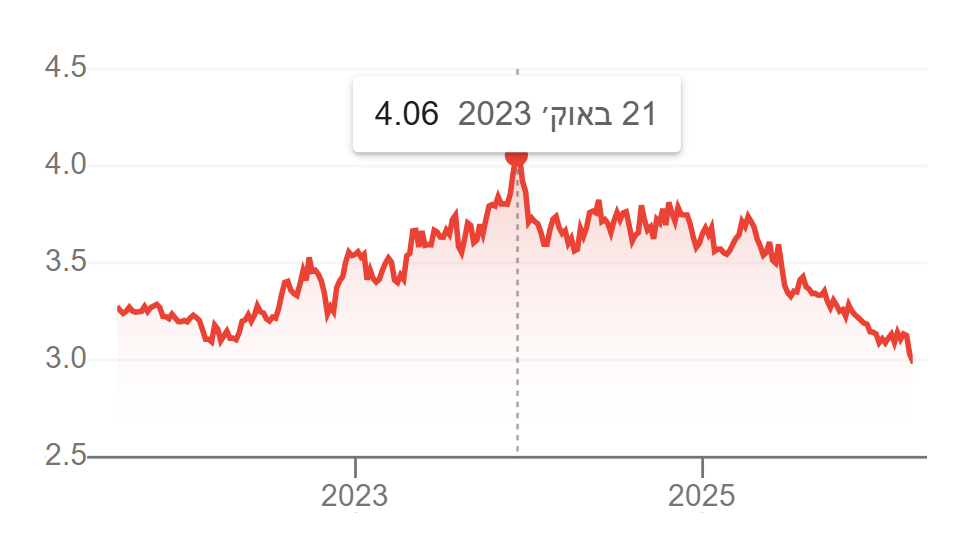
As you know, as of writing these lines, on 16/04/2026 the dollar fell below three shekels for the first time in more than 30 years.
And of course, this raises a lot of questions for a lot of people.
Bottom line – the dollar has been falling for a long time. In fact, it peaked in October 2023, when it reached a little over 4 shekels to the dollar.
We all remember what happened then, and that is quite important for what follows.
What does it mean? Over the last two and a half years the dollar has fallen by more than 25%!
Why?
What can we expect next?
And most importantly – what do we do??
So I'll start with the why, because it's the easiest part, but it will also help us understand where this could go.
Why has the dollar weakened?
First of all, since October 2022 the dollar has weakened globally by about 13%, and since Trump took office by about 10%.
In other words – in recent years, and especially in the last year and a half, the dollar has been in a downtrend. This has nothing to do with Israel or the shekel.
As much as we are a "global superpower" 😊 we have no influence whatsoever on the dollar exchange rate in the world.
At the same time – since January 2025 (when Trump took office) the shekel has strengthened against the global basket of currencies by roughly 10%.
Now – are all these numbers confusing? Rightly so. And truth be told – they are not very important either.
What is important for us to understand is that over the last two and a half years the shekel has strengthened and the dollar has weakened at the same time, which caused a very significant strengthening of the shekel against the dollar.
Against the euro, for example, the shekel has risen by about 16% since October 2023, compared with, as mentioned, 25% against the dollar.
Why has the dollar weakened?
Simply put – because it is good for American exports and for American debt, and so the US, mainly Trump, wants the dollar to weaken.
At the end of the article there are two sections for the more ambitious readers – one explains how currency fluctuations affect exports and debt, and the other explains how interest rates affect exchange rates.
And why is the shekel strengthening?
If we set aside for a moment the rise in the dollar rate that happened around the start of the war – the price of the shekel, like any product (including the dollar), is determined by the laws of supply and demand.
Over the last two and a half years there has been high demand for shekels; many people want to buy them, and so their price has gone up.
Who are these people buying shekels, and why are they doing it?
First of all – investments in high-tech. The world is investing a lot of money in Israeli high-tech.
This money comes into Israel in the form of dollars, and a large part of it is converted into shekels, for example to pay employee salaries, rent and so on.
This creates increased demand for the shekel = a rise in its price.
Second – high demand for Israeli government bonds – in recent years the Israeli government has issued a lot of bonds (taken loans), some of them in dollars.
Here too – the world pays in dollars and part of the money is converted into shekels.
And one last thing that is a bit more "fluid" – general confidence in the resilience of the Israeli economy.
It's a statement that can't be quantified, but it shows up in all kinds of ways, for example in the investments and bond purchases mentioned above.
What can we expect in the future?
So we understand why the shekel is strengthening and the dollar is falling.
Now we get to the future – unfortunately, yesterday the cat broke my crystal ball, so I don't know what will happen.
I'm not talking about a scenario of security escalation, although recently we have seen the shekel show great resilience even in the face of such escalations, but about a business-as-usual scenario.
If demand for shekels continues – the shekel will keep rising. If the US government keeps trying to push the dollar down – the dollar will keep falling. As for the euro – if the shekel strengthens, it will strengthen against it too, though perhaps less than against the dollar.
Now, bottom line – I have no idea. I don't know whether the shekel will keep strengthening, and if so, by how much.
Maybe it has reached its peak and from here it will start to decline, stabilizing around 3.2-3.5 shekels to the dollar.
Maybe it will keep strengthening and we'll see 2.5 shekels to the dollar too. Maybe 2? I find it hard to believe, but there's no way to know.
"Great, Gad, you've really helped me a lot."
True, I know. It doesn't really help.
So what can we do after all?
First of all – at least in theory – the dollar "has more room" to rise than to fall.
So if you planned dollar expenses (eBay, Temu and others, trips abroad) – it's worth taking advantage of this and buying now. Of course, this is not an excuse to buy things you didn't plan, but if you intended to anyway, you can take advantage of the low dollar.
As for the world of investments – that's more complex, because the price of a mistake is higher.
On the other hand – if we believe the dollar will rise – then we'll buy dollar assets.
From dollar money market funds, through indices such as the S&P500 or the Nasdaq, all the way to apartments abroad, in the US, Greece or Spain, each according to what suits them.
If we think the dollar will fall further – then we should do the opposite and actually get rid of dollar assets.
What's important to understand – nobody really knows. Not even those who position themselves as some world-class expert or another.
Half say one thing and the other half say the opposite, and in the future, when we know what happened – the half that happened to be right will present themselves as experts, financial geniuses and so on.
In my opinion, there are two things that can guide us:
The first – if we live in Israel and make our money in Israel – there's no point in dealing with it.
We live in a shekel world, we have no influence on the dollar rate, and the dollar rate doesn't have much influence on us either.
The second, something I always like to recommend as a decision-making tool – it's worth asking ourselves which mistake would hurt us more.
If we invest in dollars and it keeps falling, or if we invest in shekels and the dollar goes back up? When would we be more upset?
When would we be angrier at ourselves?
One of the things you can do is half and half. Then – if the dollar rises – the dollar half gains and the shekel half doesn't, and of course vice versa.
As I wrote – I don't have a crystal ball. I don't know what will happen. And neither does anyone else.
And so – making a decision based on the price of the pain is a good way. And half and half is not a bad way at all either.
And now, as promised, for the more ambitious readers:
Why is a weak currency good for exports, and vice versa?
Truth be told? Pretty simple. Let's say I'm an exporter. I sell abroad. Software, drip irrigation emitters, you name it. I get paid in dollars and pay salaries and rent in shekels. If the dollar strengthens (= the shekel weakens) – my income is worth more shekels, and then I'm left with more money in hand. Of course – if the shekel strengthens – exactly the opposite happens. And if I'm an importer and not an exporter – everything is reversed. I like a strong shekel and don't like a strong dollar.
And why is a weak currency good for debt?
The US has external debt of about 39 trillion dollars. That's a lot, really a lot of money. Its debt-to-GDP ratio is around 124%, compared with, for example, around 70% for Israel. This means the US owes the world much more than its economy produces each year.
Since this debt is denominated in dollars, if the dollar weakens – the real value of the debt goes down.
And what determines exchange rates, apart from what I've already described above?
The central bank's interest rate. This is a country's most powerful tool for influencing its exchange rate, and I'll explain.
If the central bank raises the interest rate, say from three to four percent – then it becomes more worthwhile to buy its bonds. More bond buyers = more demand for the currency = a strengthening of the currency.
Let's say, for example, that the Bank of Israel's interest rate is 4% and that of the American Fed is only 3%.
In such a situation – more people will want to buy Israel's bonds, there will be high demand for shekels, and the price of the shekel will rise (= the dollar rate will fall).
To sum up
I know the subject is complex, and I also know I haven't given here some kind of "recipe" for what to do in this situation. Simply because there isn't one.
Exchange rates are a very speculative thing and there's no way to know which direction they'll go. You can gamble, but gambling is not a plan of action.
Another option – to hedge. To go half and half.
I am not a prophet and I don't have a crystal ball.
Everything written in this article that looks to the future is my personal opinion only, and every reader is invited (and even expected) to do their own research and reach their own conclusions independently.
Nothing written here should be considered an investment recommendation of any kind.