Congratulations! You are on your way to buying an apartment and plan to take out a mortgage. It may be the biggest deal of your life. And there's no doubt – it's not simple. It's hard to make decisions about so much money without understanding it well enough. That's exactly why I prepared the following guide, to help you approach the subject with more confidence and less stress and worry.
Good luck!
Table of contents:
- What is a mortgage anyway?
- What are the things we must know?
- Financing percentage
- Payment-to-income ratio
- Credit rating
- A sound property
- Insurance
- The stages of taking out a mortgage
- Approval in principle
- Signing the contract and reporting
- Appraisal
- Collateral
- Receiving the money
- A smart mortgage - building the right mix for us (advanced)
- The types of interest in a mortgage
- Considerations in choosing the different tracks
So let's go, let's dive into the practical stuff!
What is a mortgage anyway?
A mortgage (Mashkanta) is a loan given to us by a financial institution, usually a bank, and in return for the loan we pledge our property in its favor. The meaning of the pledge is that if we don't keep up with the payments, the bank can take the property from us and sell it to cover the loan. Since this practically never happens, banks consider a mortgage a very low-risk loan, and therefore they give it on much better terms than regular loans, the so-called "solo loans". First of all - you can get much larger amounts, second - for a much longer period, and third - at interest rates that are usually much lower.
What are the things we must know?
Since on the one hand we receive a lot of money and on the other hand we pledge our property - everyone wants this to work. We do, the banks do, and so does the Bank of Israel, which supervises them. To ensure this, a number of rules were created for mortgages that, on the one hand, make taking one quite cumbersome, and on the other hand greatly reduce the risk for all parties. What are those rules?
Financing percentage
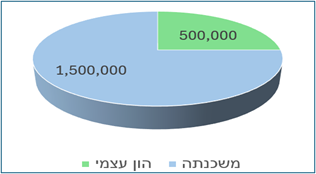
The financing percentage tells us how much money we can get relative to the value of the apartment. For buying a first apartment in Israel, the maximum financing percentage is 75%. That is - for an apartment worth a million shekels we can get a 750,000 mortgage, for two million 1,5 million, and so on. The value of the apartment is determined by the principle of "appraiser or contract, whichever is lower" - I'll elaborate on this later.
Payment-to-income ratio
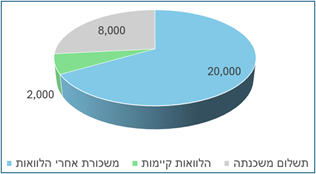
The payment-to-income ratio (Yachas Hechzer) is the ratio between our net salary, minus existing loans if any, and the monthly mortgage payment. The maximum ratio in Israel is 40%. Sounds complicated? Let me simplify with an example: suppose we earn 22,000 shekels net and have a car loan of 2,000 shekels a month. The bank will approve a mortgage with a monthly payment of up to 8,000 ₪, that is - 40% of 20,000. This doesn't mean we have to take such a mortgage, but if the monthly payment for the amount we plan to take exceeds 40% of our net income minus obligations - it won't be approved. Rent, municipal tax (Arnona), bills - are not counted as obligations. Only loans that end more than a year and a half from now.
Credit rating
One of the most important parameters! When we take out a mortgage, we are tied to the bank for many years. The bank wants to see that we are reliable customers who won't cause it problems. Who are unreliable customers? The kind banks don't like?
First of all - those who don't meet their obligations. If standing orders of ours bounced, if we had credit card charges that weren't honored, or checks that bounced due to insufficient funds - it will be hard for us to get a mortgage. We must make sure we honor all our obligations. Something else banks don't like - frequently exceeding the credit line (the overdraft). If there's a month with a lot of expenses and we might exceed it - contact the bank and ask to increase the limit, at least temporarily, so that we don't exceed it.
A sound property
When we take out a mortgage - the bank places a lien on our property as security. If we don't keep up with the payments - it may take it from us. To make sure the property really exists and that, if it has to, it can sell it in the future - the bank wants to verify that the property is sound and legal. Properly registered in the Land Registry (Tabu) / Israel Land Authority (RAMI), with no liens or attachments on it (other than the mortgage), and no problem either buying it or selling it in the future. The people responsible for verifying this are our lawyer and the appraiser. If we're buying an apartment from a developer - of course everything is in order and much simpler.
Insurance
The bank wants to make sure that even if, heaven forbid, something happens to us or to the property - it will still get its money. Therefore it requires us to take out life insurance for all the borrowers on the mortgage and pledge it to the bank, as well as building insurance, so that if the property is destroyed (earthquake or fire) - the insurance company will pay the bank.
The stages of taking out a mortgage

As we've already understood - a mortgage is a somewhat complex business, which is why it's divided into several stages. Each stage is another step on the way to the longed-for apartment. If you approach them with a bit of patience and in an orderly way - it's not as scary as it seems.
Approval in principle
An approval in principle (Ishur Ekroni) is a document that essentially confirms that we are eligible to take out a mortgage, regardless of the property we're buying. It states the mortgage amount we can get based on our income and our credit rating. You can get an approval in principle even if you haven't found an apartment yet. And if there is an apartment - this is the first stage in the purchase process, before signing a contract or even a memorandum of understanding.
How do you get an approval in principle?
Google "mortgage approval in principle" and the websites of all the banks come up. There you fill in the details about our income, our equity, and how much money we're asking for. If you already have an apartment - fill in the apartment's details. If not - you can "invent" an apartment whose general characteristics are similar to the apartment you actually intend to buy. It's important to give true figures about income and equity; these are figures the bank will check later. If we cheat - we'll get an approval in principle, buy the apartment, but not get a mortgage, and then we'll be in big trouble. If problems might come up (for example - half a year ago a check of mine bounced because my salary came in two days late) - it's recommended to call the call center rather than fill it in digitally, so we can explain, or alternatively, to work through a mortgage advisor who will manage to "get us through".
Signing the contract and reporting
Mazal tov! We have an approval in principle! Now we can sign a contract. When we sign a contract - the lawyer handling the deal reports it to the Tax Authority. The bank will ask to see the signed contract (original or scanned), the copy of the lawyer's report, and also a document called a "declaration of accuracy", in which the lawyer declares that their report was accurate.
Appraisal
After the approval in principle and signing the contract - the bank will refer us to an appraiser. The referral appears in the approval in principle document. The appraiser will inspect the property, check that there are no building violations and similar problems, and also estimate its value. The appraiser's assessment is important because it may determine the mortgage amount we're ultimately approved for. As mentioned above - the bank sets the financing percentage according to the principle of "appraiser or contract, whichever is lower". If our contract is 2,000,000 ₪ and the appraiser valued the apartment at 1.9 million - we'll get a mortgage of up to 75% of 1.9 million. If the appraiser valued it at 2.1 - we'll get 75% of 2 million. If we're tight on money, buying the apartment with our "last shekel", and need a mortgage of 75% of the contract - it's recommended to get an early appraisal: approach an appraiser before signing the contract to estimate the apartment's value. It's admittedly more expensive than an appraisal through the bank, but - if we don't have enough money - we may find ourselves unable to complete the deal.
Collateral
The last stage of taking out the mortgage - before the bank transfers the money to the seller (it's always transferred directly to the seller and not to us), it wants to make sure the property is really pledged in its favor and that it can realize it if it has to. We receive from it a number of documents that we need to fill in and return. Almost all of them are for the lawyer to handle. If we're buying from a developer - then the developer's lawyer. The main thing we need to do - life insurance and building insurance. If the apartment is under construction - no building insurance is needed, because there's nothing to insure yet.
Receiving the money
That's it! We've completed everything! It was a long journey, but it has come to an end. After we return the signed collateral documents to the bank - it will transfer the mortgage money to the seller. If it's a second-hand apartment - the first money will go to cover the seller's existing mortgage, and only after the bank receives proof that it was really covered and that the other bank removed the lien from the apartment - will it transfer the balance to the seller themselves. If it's an apartment from a developer - we need to give the bank the payment voucher booklet we received from the developer, and the bank will pay the vouchers themselves according to the contract's schedule.
As for our payments - we only pay for what we've taken. If we asked for a mortgage of a million shekels and the first installment was 200 - the monthly payment will be based on 200. The next installment is another 200? The payment will be based on 400, and so on.
A smart mortgage - building the right mix for us
This is an "advanced" section, so if you don't have the patience – skip it
A mortgage is a loan usually made up of several tracks. Each track can be for a different period of time, with a different type of interest and a different interest rate as well. How do you know what to take?
The types of tracks in a mortgage
There are many possible mortgage tracks, but we'll talk about the main ones:
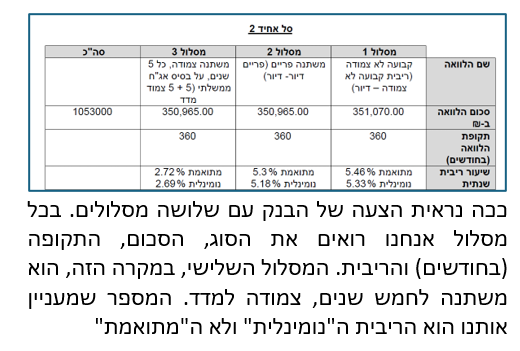
- Fixed interest, which can be unlinked to the index (fixed unlinked, KALATZ) or CPI-linked (KATZ/KATZAM). It appears in the image on the right side (track 1). The difference between linked and unlinked is explained below.
- Variable interest based on Prime. It appears in the image in the middle (track 2) - this interest can change every month, every two months, or stay fixed for a long period, depending on the Bank of Israel interest rate.
- Interest variable every year/two years/five years based on bonds. It's in the image on the left side (track 3) - this interest is fixed for the period that appears in its name, and afterwards it can change. It too can be CPI-linked (MATZ) or unlinked (MALATZ).
This is what a bank offer with three tracks looks like. In each track we see the type, the amount, the period (in months) and the interest. The third track, in this case, is variable every five years, CPI-linked. The number that interests us is the "nominal" interest and not the "adjusted" one
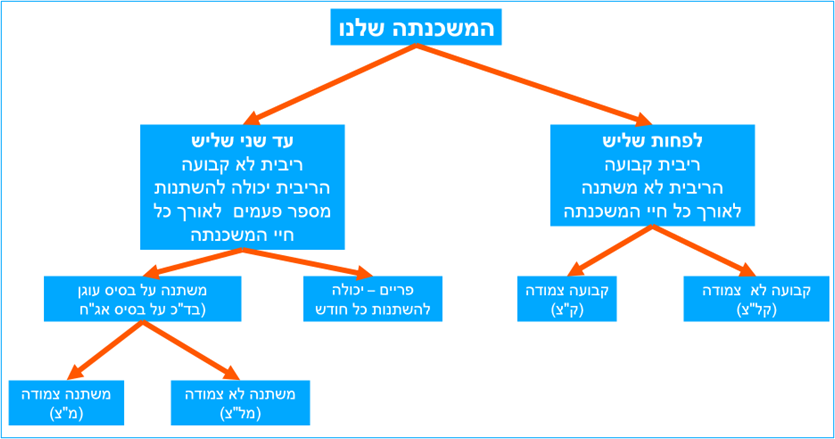
You can look at it like this:
Considerations in choosing the different tracks

We often want to take out a mortgage so that the monthly payment is as low as possible. Usually, if we build such a mortgage - it will be a bad mortgage, and over the years we'll pay the bank a great deal of money, possibly more than twice what we took. Why, actually? The way to get a low monthly payment is by spreading the mortgage over a long period, say 30 years. If we spread the mortgage over 30 years, then each payment is relatively low and we hardly reduce the mortgage balance. The meaning - we keep paying interest on a high principal. A good few years pass until the principal starts to go down, and with it the interest we pay. This is where the myth that "at first you pay only interest and only later principal too" was born.
If we went even further and, in addition to the long spread, also took a linked interest rate - a situation is created in which our principal is linked to the index and grows every month faster than we reduce it. In such a situation - we only start reducing the principal after a good few years, and in five or seven years - we'll find ourselves owing the bank more than we took. In addition - with linked interest, the payment is also linked and keeps growing every month. So our initial payment will be relatively low, but after two or three years it will already be high, and after ten years or more it will be very high.
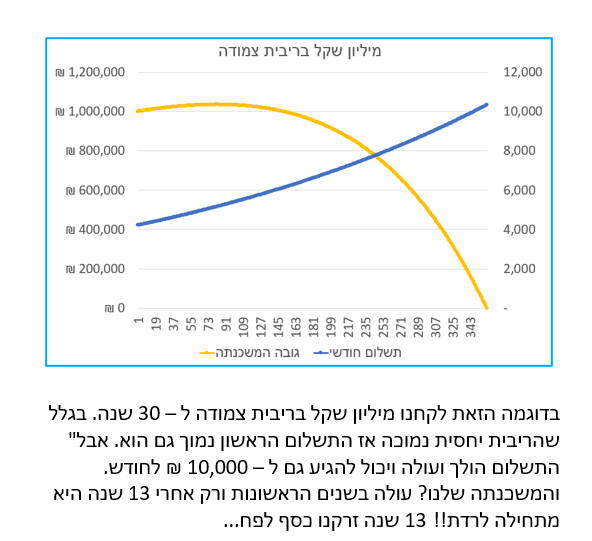
In this example we took a million shekels at linked interest for 30 years. Because the interest is relatively low, the first payment is low too. But the payment keeps rising and can even reach 10,000 ₪ a month. And our mortgage? It rises in the first years and only after 13 years does it start to go down!! For 13 years we threw money down the drain...
And how does the Prime track behave?
In the Prime track, as we said, the interest can change once a month, every two months, or remain stable over a period. The one who sets the Prime rate is the Governor of the Bank of Israel, and the bank where we took the mortgage has no influence on it at all.
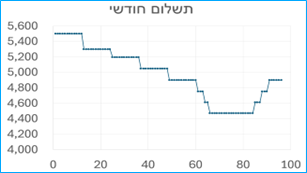
In this example we took a million shekels at Prime interest for 30 years. In the first years the interest gradually goes down, and with it our monthly payment. After a few years – it starts to rise, and with it the monthly payment rises too
What are the other considerations?
Another consideration is a future early-repayment (prepayment) fee (Amlat Hivun). Familiar with the term "exit penalties"? Well, the thing is, there's no such thing. You can close or refinance a mortgage whenever you want. And now pay attention: if on the day of closing/refinancing - the average interest rate in the economy is lower than the rate at which we took the mortgage - we'll pay a prepayment fee, what's called an "exit penalty". What is it actually, and why do we pay it? The bank sold us money at a certain price. That price is the interest times the period. If interest rates in the economy have dropped and we want to return the money to the bank - it will sell it to someone else for less than it sold it to us. It will earn less than it planned. What does it do? It charges us its loss. That's the prepayment fee, or what's called an "exit penalty". In practice - because of the exact way it's calculated - the higher the prepayment fee, the more worthwhile it is to refinance the mortgage. A high prepayment fee means the bank loses a lot of money on the refinancing/closing, and in this case - money the bank loses was supposed to come out of our pocket, so we gain.
As mentioned - the prepayment fee is the interest difference times the period. In the Prime track - there is practically no prepayment fee. In the variable track - the prepayment fee is calculated up to the next change point (one year, two, five), so - even if there is one - it will be very low. Where can it be significant? In the fixed track. Here the fee is calculated until the end of the track's period, so it's worth making an effort to shorten it as much as possible. That way we both pay less overall and save future prepayment fees.
In the end - the mix we take, the combination of tracks - is a result of our financial abilities, our future plans and our risk assessment. If, for example, we think the Prime rate is going to drop in the coming years - we can include more Prime. If not - maybe we won't take Prime at all. If we can handle a relatively high monthly payment - we'll take a short period, mainly for the fixed track. There's no one mix that's right for everyone, so each of us needs to make our own considerations.
Summary
A mortgage is something most of us will take once or twice in our lives. It's a lot of money with a lot of implications, so it's worth understanding what we're doing and making the right decisions. On the one hand - it's a somewhat tiring process, but on the other hand - everyone does it and it's absolutely doable. With a little knowledge and a little patience - we'll get through it safely and without too many gray hairs.
If you want to know more or get help – you're welcome to pick up the phone, write a message or send an email and I'll try to help.
Good luck!